06.20.04
Posted in Gay rights at 5:55 pm by ducky
Three thousand, seven hundred and forty-eight. That’s a really tiny number in some contexts, like in the number of stars in the sky, the number of fish in the sea, or the number of people born in the world. In the context of the number of postcards that I just had to design, get printed, get cut, make address labels for, affix address labels to, and put postage stamps on, it is quite a large number.
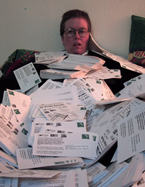 These cards went out to all the same-sex couples in California, Nevada, Oregon, and Washington who got married in February and March 2004 at San Francisco City Hall. The cards invited them to march with Marriage Equality California in the upcoming San Francisco Lesbian, Gay, Bisexual, and Transgendered Pride Parade.
While I had some help (particularly from my beloved husband), I probably affixed three thousand labels and stamps myself over the course of this weekend. This activity supports my thesis that activism is boring.
However, it was uplifting as well. Every address label represented one more happy couple. Carl and James. Ruth and Janet. Joseph and Eric. “Happy couple, happy couple, happy couple”, I said to myself as I stickered, remembering the joy I’d seen at the city hall weddings. Bernheisel and Winters. Stockton and Minns. Curry and Medina. Happy couple, happy couple, happy couple.
Some of the names looked like they could be straight couples: Paul and Lisa, Leslie and Stephen, Drew and Laurens. I presume they got married in San Francisco during the period when same-sex couples were marrying, and got included in the list purely by proximity. I wondered how they felt about getting gay-themed mail.
There were a quite a few couples with the same first name: Maria and Maria, Barbara and Barbara, Michael and Michael. Many couples already had the same last name: Crabtree-Ireland and Crabtree-Ireland, Disney and Disney, Dick-Endrizzi and Dick-Endrizzi. Happy couple, happy couple, happy couple.
Over and over and over again, for three, five, seven, eight hours, I stickered. Forty-two Amys. Fifty Elizabeths. One hundred and thirty-two Davids. Happy couple, happy couple, happy couple.
Seeing so many couples whose lives had been changed by Newsom’s act of civil disobedience was a visceral reminder that marriage equality is something worth fighting for. If somehow these stickerings make even one more happy couple, I’m happy to do it. So Suzanne and Susannah, Michelle and Susan, Zackary and Steven, thanks for the inspiration!
(Here is the postcard design as a 1.3M PDF.)
Permalink
06.12.04
Posted in Married life at 6:34 pm by ducky
Seventeen years ago, my beloved husband dropped out of his masters’ in computer science program to go to Japan. While he took a few classes here and there afterwards, he was still short four courses.
This how he came to take two classes each during the past two quarters. This was in addition to working full-time, serving on the boards of Marriage Equality California and EQCA, singing with the San Francisco Symphony chorus, and taking part in numerous marriage rights-related activities. This is a lot. I’m amazed that anybody could do it.
I assume that I helped. It’s hard for me to quantify exactly what I did that was different, since he still did almost his fair share of the household chores (instead of more than his fair share like before). Partly I just didn’t ask much of him. For example, I didn’t ask for any help in prepping the front door for painting. Regardless, I felt really busy with him in school, and certainly I missed having as much of his attention and affection.
Thus I was very ready for him to graduate. So was he. We were both thrilled when Stanford University informed him that he had completed all the requirements for his Master of Science degree in Computer Science!
He originally wasn’t going to go through commencement — he was a little embarrassed about it, feeling that he’d had his chance seventeen years ago — but I and others persuaded him that no matter what happened seventeen years ago, this was still something very much worth celebrating.
On the day of graduation, he was a bit late and so just carried all his commencement regalia over to the staging field in a tidy little black bundle. (That was probably a good move — I remember that the gowns were hot!) I kissed him and went into the stadium, assuming that the classmates he said he was meeting up with would help him make himself beautiful. Little did I know.
At the appointed hour, a great cheering mob of students raced onto the field, complete with an amazing variety of costumage and paraphernalia. There were students dressed as palm trees and sea dragons. There were people throwing beach balls around. There were thirteen students dressed up in the individual letters A-L-P-H-A-C-H-I-O-M-E-G-A. There was a giant S made out of red balloons. There was even a crew that set up a slip-and-slide track. But there was no husband that I could see.
I started sending frantic text messages from my phone to his.
Me: Where u
Jim: Take a seat, enjoy show.  See if you can ID me.
Me: Enjoying show no prayer of finding you w/o fish on yo head o something
I was expecting, hoping, waiting for him to tell me where he was, something like “now nxt 2 balloon S” or something like that. I got a little annoyed that he didn’t give me clearer directions. How on earth was I supposed to spot him in that mass?
Still nothing.
Then more people started entering the stadium, this time in ordered lines walking in single files, with different hood colors in each line. “Ah,” I said to myself, “the graduate students. He’ll come in soon.”
More orange hoods and more orange hoods and more orange hoods came in the stadium, passing about fifty feet below me. I kept looking and looking — you’d think I’d be able to pick out my favorite husband, especially since he was probably one of only three students in miles with a red beard.
Still nothing.
Me: Still no c u
I looked up from my cell phone and saw him! There he was — with a giant duck on his mortarboard, in homage to the duck I wore on my mortarboard when I got my BS! For those of you who don’t know how his mind works, this was his way of saying thank you to me for two quarters of him being missing, and I knew it immediately. I just went nuts, hooting and a hollering.
Me: I cu!!!
Me: O my love, o my love!
    Hard to wear, isn't it?
He’d managed to keep it a secret from me, which was also impressive. That trip over to neighbor Ron’s on Wednesday to talk about the condo association’s garage repair? They actually spent most of the time drilling holes into the mortarboard. The phone call from the classmates he was going to meet? Ron, asking if he should drive the duck over yet. Jim taking his gown over in a little bundle instead of wearing it? To hide the fact that his mortarboard wasn’t there.
Yet again, he made me happy that I married him.
P.S. A lot of people thought the duck on my mortarboard was a goose, but it was actually, genuinely, a Pekin duck, the most common domesticated duck. I think Jim’s bird truly is a goose, but that doesn’t matter. I understood.
Permalink
Posted in Gay rights, Politics at 5:51 pm by ducky
When my husband told our neighbors as we passed that we were off to staff a booth at the San Jose Gay Pride Celebration, they said it sounded exciting to be activists.
Oh, how wrong they are. At its best, activism is fundamentally boring. You might have mental images of a tight cadre of people in intense planning in rallies, perhaps bonding in solidarity in civil disobedience. In reality, time spent on activism these days is mostly spent on these activities:
- figuring out what events to put on
- organizing the logistics for the event
- convincing other people to show up at the event
- showing up at the event
Figuring out what events to put on is somewhat frustrating, as it’s really hard to come up with ideas for things that haven’t been done before.
Organizing logistics for an activism event is not much different from organizing logistics for any other event. You need to fill out paperwork, coordinate activities, fill out schedules, arrange the audiovisual elements, decorate the set, etc. etc. etc. Furthermore, activist organizations usually do not have the luxury of having lots of money, so the logistics are not as straightforward. For example, instead of just hiring somebody to deliver and operate a sound system, the preference is to call around to a lot of different people to try to cobble together pieces of a sound system into a usable whole.
One of the logistical pieces is convincing people to come to the event. This is difficult not just because people are over-committed these days, but because the events are fundamentally boring (see below).
While there is some variation in events, most fall into one of these major classes:
- public demonstrations (rallies, protests, parades)
- governmental meetings
- information tables/booths
- fund-raisers
For governmental meetings, the most important thing is to show up, to impress upon the governmental officials that your side has more bodies than their side. Governmental meetings, by definition, are run by public servants — who are self-selected for enjoying the sound of their own voice. There is also usually a time for public comment, at which point you make your most important arguments (over and over and over) and the loyal opposition makes their most important arguments (over and over and over). For contentious issues, the public comment can last for several hours — and the speaking skills of the public usually does not compare favorably to those of public officials.
In addition to public hearings, you get to go to rallies. Attending a rally means standing with a bunch of people who agree with you and listening to someone who shares your values telling you stuff you already know. It is not educational for you, and passer-bys rarely stop for more than thirty seconds, so they don’t learn much either. That’s okay, because the point is not to educate anybody at the rally, but to get on TV. Thus it’s not important to have interesting speakers, but to have material that looks good on TV.
Staffing an information table can occasionally be interesting if you get into a dialog with somebody who stops by, but also involves a whole lot of sitting around and waiting for people to come by.
Going to fund-raisers can actually be a whole lot of fun, as you are usually with a bunch of people who share your value priorities in a congenial situation. There is that one annoying little part about feeling obliged to actually give the organizers money, however…
It almost seems like unpleasantness is the currency of activism, a way of saying to the world, “Look! I believe so much in this cause that I am willing to endure this much unpleasantness.” That certainly worked for the racial civil rights movement, where seeing activists enduring being beaten, hosed, and set upon by police dogs was highly compelling.
It is perhaps a testament to how tame the issue of gay rights in California is (for a straight woman) that the worst I need to endure as an activist is boredom.
Permalink
06.08.04
Posted in Married life at 10:36 pm by ducky
My husband Jim and I have very traditional gender roles. We just have them backwards. He cooks, I take out the garbage. He wanted a big white wedding, I wanted to elope. He wants kids, I want to burp and play video games in my underwear. He’s nurturing, I’m competitive. When one friend of mine told me that all human actions boiled down to competition and nurturing, I went straight home and told Jim, “I can be more nurturing than you can!!!” Jim, naturally, assured me that he was confident that I could achieve that goal and that he would wholly support me in my efforts.
As you can see, he’s just brutal in competitive nurturing. He just figures that he earns domestic credits whenever he’s nurturing, and that those will be useful in case he needs to spend them later. The problem is that he has earned so many that Alan Greenspan’s going to start warning him soon about domestic credit inflation.
One way that Jim earns domestic credits is by handing me my towel every day when I get out of the shower. (Usually we shower together and usually he starts and finishes first.) Since he was being so nice, I had to start handing him his towel, too, if for some reason I was out of the shower when he finished. When I got into it, of course it got competitive. As soon as the water stops, BING BING BING it’s off to the races! If the person showering gets to the towel first, the showering person wins!
The best part is that if the wet person wins, the dry person has to grovel and acknowledge the winner’s superiority and dominance in all things. (Aside: can you imagine if the sports were like that? I’d watch boxing if I there was a chance of hearing Mike Tyson say, “You win. You’re better than me. You’re superior and dominant in all things.”)
The interesting thing about this game is that the, winner earns some domestic credits and the loser spends some credits.
Another way to spend domestic credits is to cause an argument. Our favorite argument is about time. See, I’m a pessimist. I think it’ll take an hour to get anywhere. My husband’s an optimist. “Oh, we can make it to San Jose Airport from Palo Alto in ten minutes!” “At rush hour???” “Ok, twenty-five!”
He was way, WAY late the night before one performance of Carmen, when we were both in the chorus. He was supposed to swing by and pick me up to take me to the theater, but I could have walked to the theatre both ways uphill barefoot in the snow by the time he finally showed up.
Unfortunately, I spent a bunch of domestic credits by overreacting. It wasn’t actually his fault and we did make our entrances (barely). Maybe I was just a wee bit on the edge from the sleep deprivation from thirty-nine hours of rehearsals in the previous week and from the heart attack in the front row at the performance the night before.
By the time we got home, we were exhausted. We fell into bed like skydivers without parachutes.
Unfortunately, the next day, we had an important meeting at some painful hour of the morning. I tried gentle persuasion to get Jim up, then gave up and started showering by myself. Several minutes passed with still no sign of him. I started to worry. We had to get to the meeting, but I didn’t want to yell at him too hard because of the argument the day before. I was afraid I’d go farther into domestic credit deficit.
 !
!
I turned off the water. Bang! Out of bed down the hall he raced! He was just reaching for my towel when I turned the water back on. When he realized the trick I’d played on him, he laughed — and acknowledged my superiority and dominance in all things.
Best of all, I was net positive again on domestic credits. Yessss!
Permalink
06.07.04
Posted in Married life at 6:27 pm by ducky
I folded laundry this evening.
Normally, this is not big news, but yesterday I would have been completely unable to do so. Yesterday, I woke up at my mother’s house with not just my Favorite Husband but also a seriously maladjusted inner ear. My balance was shot, and moving my head would make me violently, painfully, convulsively motionsick.
It’s pretty amazing just how horrible something “simple” like throwing up can make you feel. There were times when my body seemed to be straining to expel everything it could from anywhere it could: get it out get it out getitoutgetitout! How else to explain the immediate sheen of sweat over my entire body? How else to explain the tears?
A cousin described a bout of vomiting as being very much like giving birth: involving painful, racking, whole-body convulsions that she had absolutely no control over.
The doctor told me to expect to be down for three or four days, but thankfully that evening, after I had emptied myself completely, I achieved freedom from nausea enough to walk down the hall and exult to Favorite Husband without either falling over or wanting to puke.
I had a little bit of water the next morning and threw it right back up, so elected to pass on any further intake until Jim had driven me the two hours safely back home. A call to medical tech support taught me that dehydration can lead to nausea, and that I needed to come back to food and drink very slowly. A mild soda the night before hadn’t stayed down, so I got a bit more creative: I started sucking on peanut butter M&Ms. I’d suck slowly on one, and when it finally dissolved, I’d have another. This slow, steady influx of sugar helped enormously.
Then, when my husband sat down with his dinner beside me, for some reason, his pickle looked really good. Now, my intellectual and emotional natures rather recoiled from the pickle. A pickle? After a day of tossing cookies? My corporeal nature, however, was unfazed by popular opinion. It wanted the pickle. Body wanted four or five pickles, in fact, and Reason and Emotion wisely stood aside.
I can’t imagine any doctor ever prescribing M&Ms and pickles as sources of sugar and salt to restore electrolytes, but it seemed to work for me.
This meant that in the evening, when the dryer buzzed,
and then buzzed again,
and buzzed again
that I felt competent to fold laundry.
I also felt like it was something I needed to do, as (drumroll) my husband is in the process of taking his very last take-home final in his very last class! Yes, after only about twenty years, Jim is finally finishing his MS in CS from Stanford University! This is way cool and something that I heartily support — even if the past two quarters have been drains on both of us.
My Favorite Husband was an absolute prince while I was sick. He held my hand, held my head, helped linearize my perambulations, wiped my forehead with a wet washcloth, and spent another night at Mom’s instead of coming home to study for his exam. So even though I didn’t feel completely steady on my feet, I felt that folding laundry was the least I could do to repay his kindness.
Jim DeLaHunt, I love you very much. Thank you for standing by me in sickness as well as health.
Permalink
05.30.04
Posted in Politics, Random thoughts at 5:52 pm by ducky
There’s some very interesting research being done over at Stanford about the interplay of status, emotions, and blame. Dr. Larissa Tiedens designed some experiments that were beautiful in their simplicity and jaw-dropping in their implications.
Experiment One: Responsibility for Outcome
In the first experiment, students filled out resume forms. Pairs of students were then matched by race and gender into teams, with one assigned a subordinate role and one a superior role based on their resumes. The pair of students was placed into an office environment (with separate offices for the subordinate and superior, furnished to reflect their different status) and given forty minutes to work on a task with no clear right or wrong answer. They were motivated to do well on the problem, as they’d been told that the team that did best would win a significant cash prize.After forty minutes were up, a researcher would take a quick look over the team’s results and give a brief, preliminary evaluation of whether they had done well or poorly. A different researcher then interviewed the two individually about how they felt, and found big differences depending upon who was asked and whether they had done well (“Success”) or poorly (“Failure”). The students reported that they felt as follows:
|
Role |
| Superior |
Subordinate |
| Outcome |
Success |
Proud |
Grateful |
| Failure |
Angry and frustrated |
Guilty and ashamed |
The researchers also asked who was more responsible. In the success experience, most of the people — subordinate and superiors — felt that the superior was more responsible for the outcome. In the failure experience, most of the people felt that the subordinate was more responsible for the outcome.
The kicker is that who was subordinate and who was superior was selected randomly, as was whether the students were told that they had succeeded or failed.
This tells me that there is something very deeply ingrained in either our culture or our genes that tells us that high-status people do good things and low-status people do bad things.
Experiment Two: Monica
As it happened, the Monica Lewinsky scandal was breaking right as they were doing this research. They took different excerpts from Clinton’s deposition and showed it to two sets of students. One set saw Clinton looking angry and frustrated; the other saw him looking guilty and ashamed.They then were asked if Clinton should resign or not. The majority of the ones who saw him looking angry and frustrated thought he should stay in office; the ones who saw him looking guilty and ashamed thought he should resign.
This tells me that angry people appear high-status, and high-status people do good things. Guilty people appear low-status, and low-status people do bad things.
Experiment Three: Interview
They then taped a job interview and showed the interview to two groups of Stanford MBA students. The tapes differed in only one line: the interviewee (who was an actor) was asked how he felt about a failure condition. In one tape, he said that he felt guilty and ashamed. In the other, he said that he felt angry and frustrated.The students were then asked a number of questions. The one that really stuck in my mind was what starting salary the interviewee should get. The students who saw “angry and frustrated” said something like $60K, if I recall correctly (after two years). The “guilty and frustrated” group, by contrast, thought he should have a starting salary of $15K. One line of difference in the tape, $15K difference in salary!
This tells me that looking angry can be financially rewarding. (I did not want to hear that.)
Interpretation
Many things made much more sense to me after hearing Tiedens speak on this.
Domestic violence
I’d always wondered why people (usually but not always wives) who get beaten up by their significant others (usually but not always husbands) put up with it. Now it makes sense. If Joe beats Jane up, then Joe, being the victor, ends up in the high-status position. Having had a fight is a failure condition. How does Joe feel? Angry and frustrated. How does Jane feel? Guilty and ashamed. Who do they both feel was more responsible for the outcome? Jane. If Jane feels responsible, guilty, and ashamed, she isn’t likely to tell anybody or to seek help.
Women’s socialization
Women are socialized to “be nice”, to not make waves, to not be aggressive, to not display anger — to be low status, in other words. Ooops.
Race relations
It’s easy to see how a vicious cycle can set in regarding race relations. If a group is perceived as low-status, then people will think they do bad things and hence deserve mistreatment — which then leads to lower status, lather, rinse, repeat. Apparently the lot of the Jewish Germans suffered from exactly such a spiral. Little by little, the Nazis decreased the status of the Jews by badmouthing them, restricting what jobs they could have, making them wear special clothes, restricting where they could live, where they could go, etc. By the time that the Nazis started herding them onto trains, they were very low status — which would make German Christians think that they deserved it. I’ve also heard that genocides in Yugoslavia and Rwanda were preceded by significant amounts of derisive propaganda about the minority group.
Black/Latino/Gay/Girl Pride
When I was a (white, middle-class) kid in the 1960s, I didn’t understand the fuss about “Black Pride”. The thought of being proud that I was white seemed completely foreign to me, as I didn’t have anything to do with it! Now I understand that being proud is a high-status emotion, and feeling high-status is key to not feeling overly responsible for one’s own misfortunes. Being proud is a prerequisite to being angry about the failure conditions of your life, and being angry is a great spur to action.
Jesus’ message
One of Jesus’ main messages — perhaps the main message — was to be good to people of lower status. He was kind to lepers, prostitutes, and beggars. He was kind to a Roman centurion (the occupying enemy!) who asked Jesus to heal his slave. (“Slave” might have meant “gay lover”, but that’s a completely different subject.)
Jesus certainly seemed to understand that low-status people were blamed for more than they deserved and not given credit they were due. The parable of the good Samaritan was meaningful precisely because at the time, Samaritans were the lowest of the low. Jews hated Samaritans! Yet this good Samaritan saved the life of the wounded man when a priest and a Levite (both much higher status) passed the poor guy by. (Perhaps the priest and the Levite both thought that since the victim had clearly been on the losing side of a failure experience, that he was low-status and therefore must have deserved it.)
God watching out
I had always been puzzled when reading accounts of people who just missed calamity or who survived calamity and praised God for watching out for them. Never, however, have I ever seen anyone who had been in a calamity blame God for sending them into the path of danger. You never hear, “If I hadn’t made all those green lights, I would have missed the train and thus not have been in the crash and lost my leg. God must have it in for me.”In this context, it makes sense: God is pretty much the highest-status being there is, so God must only do good things. Satan, while powerful, is pretty low-ranking, so much do all the bad things. (Either that or they are afraid of getting God angry at them!)
Update: Here’s a paper of Tiedens’.
Permalink
02.16.04
Posted in Gay rights, Married life, Politics at 3:50 pm by ducky
After the Valentine’s Day rally, Jim and I hopped on a bus with about fifteen other couples and a reporter or two, and went off to take the message of marriage equality to a bunch of little towns in the California interior. Between the rally and the bus trip, we were away all weekend, when I really wanted to be at City Hall helping couples get married.
Thus on President’s Day, February 16, I went up to San Francisco. My beloved husband, against his better judgment, took the day off from work and classes to join me.
 The day was cold and rainy. No, that doesn’t really capture how awful the weather was. It was that kind of wet cold that grinds into your bones and numbs your feet. It was the kind of chill that creeps in slowly, and once it’s in, makes you wonder if you will ever be warm again. It was the kind of sloppy wet weather that you really don’t want to be out in at all, let alone for an hour or two.
When Jim and I rounded a corner and saw City Hall, I almost burst into tears. It looked like a hedge made of plastic, with blooms of umbrellas. There were hundreds and hundreds of people lined up around the block who clearly had been out all night in the cruel weather. To see how many people were willing to endure that misery delivered a message to me like the kick of a horse that this was something very important.
When we got closer, I nearly burst into tears again: people were jumping out of cars with cardbord carboys of coffee. “Coffee? Coffee? Anybody need coffee?” Other people were passing out doughnuts and muffins. Strangers were taking care of strangers. People were being incredibly generous, on a scale that I’ve only ever seen in the company of natural disasters.
It was about 9:05, and what we’d heard about volunteering was that we should be there at 9:00. When we got there, there were about ten people standing patiently in line. They told us that a bunch of volunteers had gone in at 8:30, and the People In Charge had told the remnants that they didn’t know if they’d need any more volunteers. So they waited. So we waited.
More people came and got in line, barely sheltered from the rain (and not from the cold) by a slight overhang. And we waited. That’s me fourth from the right in the photo below.
At about 10 AM Joe Caruso from the mayor’s office emerged and looked bewilderedly at the twenty people standing in line. He seemed stunned that twenty people would stand around in the cold and wet (remember I said it was really nasty weather?) for the chance to volunteer. He told us that they didn’t need any more volunteers now, but that maybe they would at 1 PM. He gave us a phone number to call at 1 PM. A few people wandered off, but most of the would-be volunteers hesitated. Joe finally ordered us to leave on the grounds that we were a security risk for the mayor, who would be driving in shortly. (I think he made that up, wanting us to not catch cold in the rain.) Finally, reluctantly, the line dispersed.
Jim and I went back to plan B: handing out literature to people in line, giving them Freedom To Marry stickers, and telling them about Marriage Equality California. We saw some couples that we knew here and there, and one couple that we’d met on the bus trip. We would have liked to go inside, but they were only letting in couples and witnesses.
We clearly were going to run out of materials shortly, so I found the bus-trip couple and asked them if they had brought a witness, then offered to be their witness. They were gratifyingly enthusiastic about that. So I got in line with them. The line eventually worked them through the door, through the metal detector, down the stairs, down one hallway, down another hallway, down another, up some stairs, through a light court, and then into the Recorder/Assessor’s Office. While they were standing in line, they filled out their license application and were given a booklet (as required by law) on how to prevent pregnancy.
From there, we went into the Rotunda. If you have never been inside the San Francisco City Hall, you really should. It is world-class impressive. I was told that the SF dome is bigger than the one in the U.S. Capitol, and it is ornately carved with florid designs. In the center is a staircase to beat all staircases, about two floors high and fifty feet wide.
We waited in another (shorter) line for an officiant, and eventually Supervisor Bevan Dufty came all the way down all those stairs to collect “my” couple. As we were walking up all those stairs, I wondered why Bevan didn’t just marry them in the Rotunda. What better spot could there be?
Um, the San Francisco Board of Supervisor’s Chambers. Aside from being isolated and quiet, the supe’s chambers are panelled completely in wood and lavishly, sumptuously carved. (I guess during the gold rush, San Francisco had some money to throw around — and they did!)
Dufty spent quite a lot of time with “my” couple. While he didn’t dawdle and ask about the weather, he was very respectful, deliberate, careful, and thorough. This was a pattern I saw and heard of over and over about the officiants. Clearly, the idea had gotten around that this was a very special, important day to each of the couples, and they deserved for it to be treated as such. I was glad that I had dressed up.
After “my” couple left, I was inside and a free woman, so I went and found someone with a volunteer tag on. I was determined to help! The person I found was Rob, who was taking people from the Recorder’s Office to the officiant line in the Rotunda. It’s not far — probably only fifty feet — but it’s a big and confusing place and we wanted to make everything as smooth as possible. I helped Rob with the shuttle service for a while. At some point, the Minister of Volunteers came to Rob and said, “I need four or five volunteers! Can you come?” Rob said, “Uh, I’m busy — take her!” and pointed to me. I, thinking quickly, said, “I can get you five volunteers in about thirty seconds.”
I phoned Jim (who was still outside the doors) and told him to come to the front door with volunteers; after some confusion, we got Jim and a few others in the door. It turned out that they had run out of those velvet ropes that they use to show where people should go, so we were to stand about ten feet apart and point to people which way they should go.
There was a city employee who was handing out directions to couples as they passed through the metal detectors who was complaining about being hungry. By this time it was probably around 2PM, and she had had neither breakfast nor lunch. Somebody handed me a bag of purple foil-wrapped kisses and asked me to pass them out. I gave some to the city employee, which she appreciated greatly, but even so, she suddenly disappeared, presumably to eat something. Thus I ended up handing out instructions on how to get married to happy couples coming through the metal detector. As not everybody coming through was a couple — some were city employees, some were press — I’d ask them, “Getting married?” before handing them a paper.
At one point, a slight Asian woman came through. Uncertain, I asked her, “Getting married?” She laughed and said, “Yes! No!” and laughed again before explaining, “I’m Mabel Teng!” (County Assessor Mabel Teng is one of the people who made this possible!)
For part of the day, the deputies were allowing couples to come to the door, point out their witnesses, and the deputies would let the witnesses in. At one point, however, about fifteen people — some of whom were not their witnesses, just desperate couples — muscled their way in. Shortly after that (and yes, I think there was a causal relationship) they stopped letting any witnesses in. That was most heartbreaking when a woman pleaded to get her eight-year old grandson in, her grandson who had the rings.
In part because of the friends who couldn’t get in, there was a big crowd outside. I was close enough to the doors that I could hear the crowd cheer every time a new couple emerged.
At one point, a couple in absolutely beautiful Mexican formal dress left, and a mariachi band started playing. Apparently the couple had hired the band, but the band couldn’t get in.
(While it was sad, I can understand why they didn’t feel they could let more people in. It was pretty packed, and presumably the city employees who were volunteering their time would like to go home at some point. Yes, I say that knowing full well that I got in via subterfuge. While I am absolutely thrilled that I got to be a part of it, they would have been completely within their rights to kick me out.)
As I stood there passing out instruction sheets, many couples thanked me personally for being there. The first time, I was speechless. Me? I wasn’t one of the ones who was standing out in the ick all night! I don’t deserve the thanks, it is I who should be thanking you!
At some point (3PMish?), they closed the doors. Everything at the metal detectors slowed down. Jim decided that he’d like to actually see one of the ceremonies, so he got in the “want to be a witness” line. He was at the head of the line when Michael and Ismael got to the front of the line; they had no witness, so cheerfully accepted Jim’s presence.
It turned out that they hadn’t brought any rings, so Jim shucked his wedding ring and his “practice ring” and lent them to Michael and Ismael. (I’d gotten us a pair of cheap $5 rings to wear for two weeks leading up to the wedding just so we’d be used to having rings on our fingers and hence be less likely to lose the good rings on our honeymoon. Jim liked his “practice” ring, so continues to wear it.) Jim noticed that they were very careful to give the rings right back when they were done with the ceremony. Jim is very proud to wear what he calls “his twice-blessed rings”.
That left me with a pair of deputies and two women who were both waiting for the Recorder’s Office to spit out their friends. I was chatting with them when a man came toward one of them, proudly showing a marriage certificate, beaming a smile that could have melted the Arctic icecap. I will always remember that look of pure, unadulterated, unguarded, unrestrained joy on his face.
(His partner finished up in the Recorder’s office a few minutes later — and it was someone I know!)
You’ll be happy to know that at about this time, an official came down specifically to let the eight-year-old grandson out of the crowd and into his grandmothers’ ceremony.
About this time, Jim realized that there was media all over the place who would probably enjoy getting a statement from the Policy Director of Marriage Equality California, so he started hunting reporters.
Eventually things wound down and we decided we should go. As we walked out, I whispered to my husband that he had an audience outside, so should say something. He kind of made a face like he wasn’t sure that was appropriate, but I talked him into it… and he gave one of the most eloquent impromptu speeches that I’ve ever heard him give.
I should note that my beloved husband was working full-time, taking two classes, singing with the San Francisco Symphony Chorus, and serving on the board of two non-profits. He really couldn’t afford to take that whole day off after spending Saturday and Sunday on the rally and bus tour. He has no regrets.
Permalink
02.14.04
Posted in Gay rights, Married life, Politics at 3:56 pm by ducky
For several months, my husband had helped a bit to organize a big Freedom to Marry rally in Sacramento scheduled for Valentine’s Day, 2004. They wanted to make it a really big deal with lots of people. I worried enormously that there wouldn’t be a big turnout: that they’d get set up for seven hundred and only get seven.
Well, because of the marriages in SF that had started two days ago, there was adequate interest. Way adequate. There were about a thousand people there.
There were speeches and cheering and speeches and cheering and speeches and cheering and speeches and cheering. One of the speeches was given by my beloved husband to prove that there are straight people out there in favor of equal access to marriage. (I got to stand next to him to prove that he really is straight. I remember fixating on how my pantyhose was riding down.)
 Looking out at the crowd, I remember feeling really gratified at the sea of “WE ALL DESERVE THE FREEDOM TO MARRY” signs that I saw. You see, the Freedom to Marry Coalition had printed up some large number of signs — I think 500 — for the 2003 San Francisco Pride parade. I spent quite a lot of time trying to hand out those signs before the parade with very little luck. At the end of the day, as we were leaving, we decided we really should go past where we’d left the signs to salvage any few that might be left there.
I was very discouraged to see that most of the signs were still there. It seemed like it had been a big waste of money for the coalition to print up all those signs. Looking at the huge piles of signs, I was tempted to just cut and run and let somebody else throw them away. It had been a long day — I was tired, I was hungry, and people clearly didn’t cotton to those signs. Furthermore, the signs were kind of dirty, and I had on good clothes. (If you’re going to subvert The Establishment, it helps to look like The Establishment.) Jim said that we really should take the signs home. He was right, and I knew it, but I didn’t have to like it.
So we loaded several hundred signs in the back of our car, took them home, and unloaded them into our already messy garage, where they stayed for seven months. We loaded them all into our car and took them to Sacramento with us, where we passed them out.
Thus, to see all those signs made me feel really good. I might not have wanted to collect all the signs, but we did, and that turned out to be the right thing to do.
Go to part 3 — volunteering
Permalink
02.12.04
Posted in Gay rights, Married life, Politics at 3:57 pm by ducky
Let me tell you about how it was on February 12, 2004.
For the past five years or so, my beloved husband and I have been going to Freedom to Marry events near Valentine’s Day. On February 12th, there was another rally scheduled, and I almost didn’t go.
It’s always the same old (boring) thing: ten to fifteen marriage activists, a few onlookers, a minor governmental official, and a symbolic attempt by a gay or lesbian couple to get a marriage license that would get rebuffed. At best we get a few short spots on the evening news; at worst there is no coverage at all.
Since I was already in San Francisco, I finally decided that I should probably go, plus the organizer asked me to bring a few signs. Fine.
Well.
My first clue that something was different was seeing about ten TV vans when I got out of the taxi.
It turned out that Gavin Newsom, mayor of San Francisco, had instructed the clerk’s office to issue marriage licenses to same-gender couples. I had heard that, but I had the impression that would take another week or so to get in place. I also didn’t really believe that it would actually happen before getting struck down.
However, they were ready on February 12th! That meant that all the couples who had come to our rally expecting to get rebuffed had to suddenly face the opportunity to actually get married instead. (For most, this was a microscopic leap in commitment.)
There were 10-25 TV crews there. There were at least as many, probably more, still photographers there. There newspaper and magazine reporters. There were elected officials. There were crowds of people. I don’t know exactly how many couples there were, but it was probably in the 15-30 range.
There were representatives from most of the major gay and lesbian political organizations. (I remember seeing people I knew from the National Center for Lesbian Rights, Equality California, Marriage Equality California, and ACLU, among others.)
It was a little disorganized, without particularly clear herding of the couples. For example, because of a big long line at the metal detectors, we at the back of the line lost sight of the organizers. We gravitated towards a big crowd in the Assessor’s office, but it became clear that this was folks getting ready for a press conference, not the place to get a license. So I grabbed the nearest person who looked like he might know something — Assemblymember Mark Leno — and asked where couples were supposed to be. He said the Clerk’s office, so I stuck up my hand and yelled, “All the couples who want to get married, follow me!” (and then more quietly “uh, Mark, where’s the Clerk’s office?”). We then wandered around City Hall a bit before a guard showed us where to go.
While couples were going through the license line, Mark Leno and County Assessor Mabel Teng held a press conference. Eventually, the Clerk’s Office started emitting couples with licenses. The couple would come down to the Recorder’s Office, and they would dodge through the crowd to find an officiant.
It was ecstatic bedlam. At any moment, there were usually about three gravitational wells of a solemnization happening, each with a cluster of cameras in orbit around the three participants; then cameras would spin out as that couple finished up; then a new couple would come from the Clerk’s Office and the constellations would re-form around the new couple.
There was also a constant swirling current of print reporters harvesting quotes, newly-minted spouses coursing around with the other newly-minted spouses, officiants looking for new couples, couples looking for officiants, and a few bystanders like me who were just soaking it up all the joy.
Imagine a wedding. Everybody gets happy and misty-eyed, right? Now imagine all that emotion packed into five-minute solemnizations. Now imagine three of them at once. Now imagine that it happens again, then again, then again. Now imagine that these were people who had had very little time — sometimes less than an hour — to get used to the fact that they were finally going to get to do something they had never imagined they would be allowed to do. It was an overwhelming experience for me, and I wasn’t even a participant, just an onlooker.
So the next time there’s a political event that you’re not sure you should bother going to, GO. You might be lucky enough to be an intimate witness to history in the making.
Go to part 2 — Valentine’s Day rally
Permalink
« Previous Page « Previous Page Next entries »